
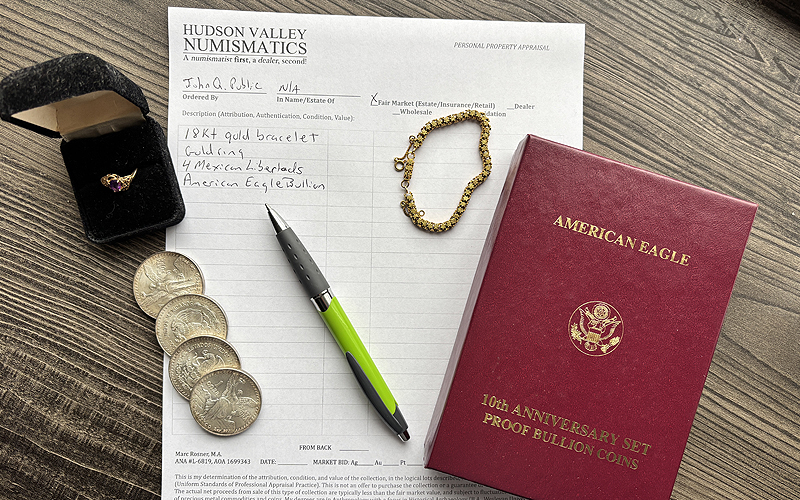
One of the most common questions we hear is: How does a coin appraisal actually work, and what happens if I decide to sell?
The process is more straightforward than most people expect, but there are a few key things to understand.
What an Appraisal Really Means
Not all appraisals are the same.
Depending on your situation, you may need:
- An insurance or replacement value
- A fair market value
- A wholesale (cash) value
- Or a liquidation value
If we ask questions about your goals, it’s simply to make sure we’re giving you the right kind of information.
Step 1: Identification
The first step is determining exactly what you have.
Is it authentic? Is it a restrike? Is it something altered or counterfeit?
Many of the most well-known coins are also the most commonly faked. We regularly see items that were purchased in good faith years ago that turn out not to be what they appear. That’s why proper identification is critical before anything else.
Step 2: Grading (Condition)
Condition plays a major role in value.
Coins are graded on a scale from 1 to 70, and small differences can mean large changes in price. A coin that appears “nice” to the untrained eye may be worth far less than expected if it has been cleaned, damaged, or altered.
Even minor issues can significantly reduce value.
Step 3: Valuation
Once we know what it is and what condition it’s in, we determine value.
This is where expectations don’t always match reality. Some coins that seem rare are actually quite common in higher grades. On the other hand, certain coins become valuable because collectors need them to complete a set.
Value is driven by demand, not just rarity.
What Happens Next
From there, the process depends on your goals.
We typically start with a conversation — by phone, email, or text — and can often give a general idea of value from photos or a description. If needed, we’ll schedule a consultation to review the collection in more detail.
For larger collections, we can meet you and handle everything on-site if necessary.
We organize items into logical groups, evaluate them, and then discuss your options:
- Immediate purchase
- Consignment
- Auction
- Or holding certain items
In many cases, we make offers on the spot. We also help determine whether items are worth sending for third-party grading before making that decision.
A Simple Reality About Selling
It’s important to understand how the market works.
If you have one coin worth several thousand dollars, an offer will typically be slightly below retail value to account for market risk. Larger collections with many lower-value items may sell at a greater discount, simply because of the time and effort required to sell them individually.
We are wholesale dealers, and our goal is to be fair, transparent, and efficient.
Our Approach
We treat appraisals and purchases as separate processes so that everything remains clear and objective.
Our goal is to help you understand what you have and give you the information you need to make the right decision — whether that means selling now, selling later, or holding onto certain items.
If you have questions or would like us to take a look at your collection, we’re always available.
And if you’d like to stay informed as we continue to share more guidance like this, we encourage you to join our mailing list.
— Marc Alan Rosner
Hudson Valley Numismatics