
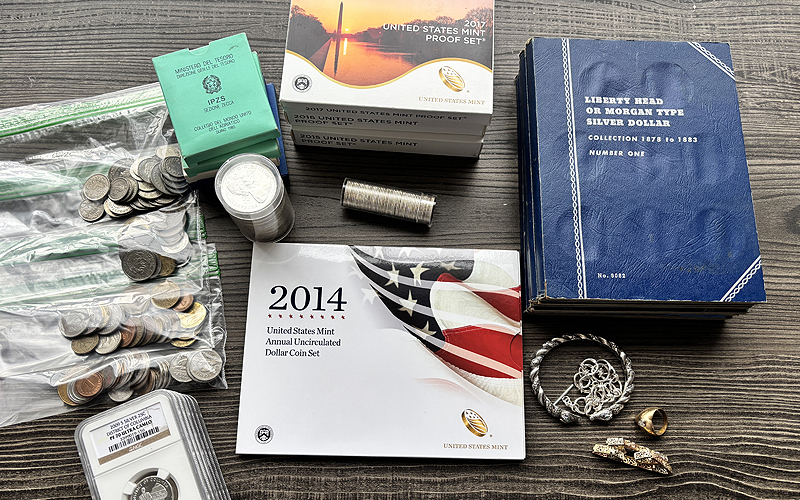
Our best clients are those who take a little time to educate themselves and research market conditions. You want to do enough homework to be secure in an offer, without wasting hours overstudying things or applying unrealistic numbers.
What Not To Do
Do not:
- Attempt to clean or repair anything.
- Hyper-organize. We recently purchased a collection where the owner had put hundreds of wheat cents in individual new holders that cost 25 cents apiece. The coins were worth under a nickel individually. Zip lock storage bags are fine. If you are driven to organize, do it by denomination — put the dimes with the dimes. Lustrous coins should be held by the edge; the less you handle things, the better.
- Rely heavily on free Internet information. We are told all the time that items “go for” hundreds of dollars online. If that were true, they wouldn’t still be available. Most free price guides are paid for by someone with a vested interest in pricing things high.
- Assume asking prices are real values. eBay listings often show asking prices, not actual sales. Auction houses show prices that include buyer fees. Grading services publish higher numbers as well — and may encourage submissions.
- Waste time on expensive coin apps. They are useful for identifying items, but often miss condition issues and tend to overprice coins.
A few quick examples:
- Any coin in your pocket can appear online for $25,000 in an unfiltered search — that does not make it worth that.
- You may see the same coin photo reused across multiple listings.
- Sellers with little feedback should be viewed cautiously.
If you are using online marketplaces, always filter for completed and sold listings, not just active ones.
What To Do Instead
Do:
- Use established price guides such as the Whitman Red Book, NGC World Price Guide, and PMG World Paper Money Guide as a relative reference, not an exact value. (The dealer-focused Blue Book is often more realistic.)
- Understand precious metal pricing. “Spot” prices reflect large trades in pure metal, not what most coins contain. Alloys (Sterling, 14K, etc.) trade differently, and dealers must factor in margin and risk.
- Grade conservatively. Tools like PCGS Photograde can help, but they do not detect cleaning or damage. Most alterations reduce value.
- Recognize how sharply pricing can change with condition. A single grade difference can dramatically affect value.
- Organize items in logical groups, and handle them as little as possible.
Understanding Real-World Pricing
Coins and collectibles often trade below published “book” values or even below melt value in practice.
Collectors and dealers operate using real market data. Many reference the CDN “Greysheet” for wholesale pricing and adjust based on demand.
An important principle:
The more common something is, the narrower the margin. The rarer it is, the wider the spread.
Examples:
- A widely traded stock may have a tiny difference between bid and ask.
- Silver may trade with a several-percent spread.
- Rare paper money or coins may have a 20–30% difference between wholesale and retail.
- Low-value coins may carry large percentage markups simply because of the time required to sell them.
This is not about greed — it reflects the real costs of buying, handling, conserving, marketing, and selling items.
Final Thought
In the end, prices are determined by intrinsic value and, more importantly, by supply and demand.
Our goal is to price material at realistic values — what things are actually trading for — and to be honest and transparent about how the market works.
If you take a little time to prepare and understand these basics, the process becomes much smoother, and you’ll feel more confident in any decisions you make.
If you’d like help reviewing your collection, we’re always available to take a look.
And if you’d like more guidance like this, we encourage you to join our mailing list as we continue adding new topics.
— Marc Alan Rosner
Hudson Valley Numismatics